🔍 Transparency Note: This review is based on an independent audit of Paddle’s 2025 fee structure. While we may earn a commission if you sign up through our links, no payment processor paid for this content or influenced our LumScore™.
Audit Context: Calculations assume a SaaS company with $50k MRR, 250 transactions/mo, and customers in the US, EU, and UK. See Calculation Methodology
Paddle vs Stripe 2025: 5% Fee & Hidden Costs Audit
Paddle charges 5% per transaction while Stripe charges 2.9%. Yet for a $50,000/month SaaS business selling globally, Paddle saves you $7,049 annually compared to Stripe’s complete tax compliance stack [8]. The reason? Stripe Tax only calculates tax amounts—you still register for VAT/GST/sales tax IDs in each jurisdiction, file monthly returns, and remit payments manually [21] [25].
This December 2025 audit breaks down the total cost of ownership for both platforms, reveals when Paddle’s Merchant of Record model justifies the premium, and exposes the API limitations your engineering team will hate (but your CFO will forgive).
Before we dive into the granular cost breakdown, here is the executive summary of our audit findings:
Paddle
LumScore™The Verdict: "The only viable payment stack for founders who fear tax audits more than API limits."
✓ The Good
- Saves $7,049/yr vs Stripe + Compliance Stack (at $50k MRR).
- Zero Liability: Paddle assumes legal responsibility for tax audits (MoR).
- Global Reach: Instantly compliant in 100+ jurisdictions (VAT/GST).
- AI Recovery: Includes ‘Paddle Retain’ to recover ~10% of failed payments.
- No Admin: Eliminates 15-20 hours/month of finance reconciliation work.
✕ The Bad
- API Rate Limits: Hard cap at 240 requests/minute (vs Stripe’s 6,000).
- Rigid UI: Cannot fully customize checkout CSS (PCI requirement).
- Cost: 5% fee is expensive if you only sell domestically (US-only).
- Payouts: Minimum payout threshold exists; transfers aren’t instant like Stripe.
The $38,549 Problem: What Stripe’s 2.9% Doesn’t Include
Stripe Tax is not a Merchant of Record—it’s a tax calculation engine charging an additional 0.5% fee [21]. For a $50k MRR SaaS with customers across the EU, UK, Australia, and multiple U.S. states, your actual monthly cost with Stripe looks like this:
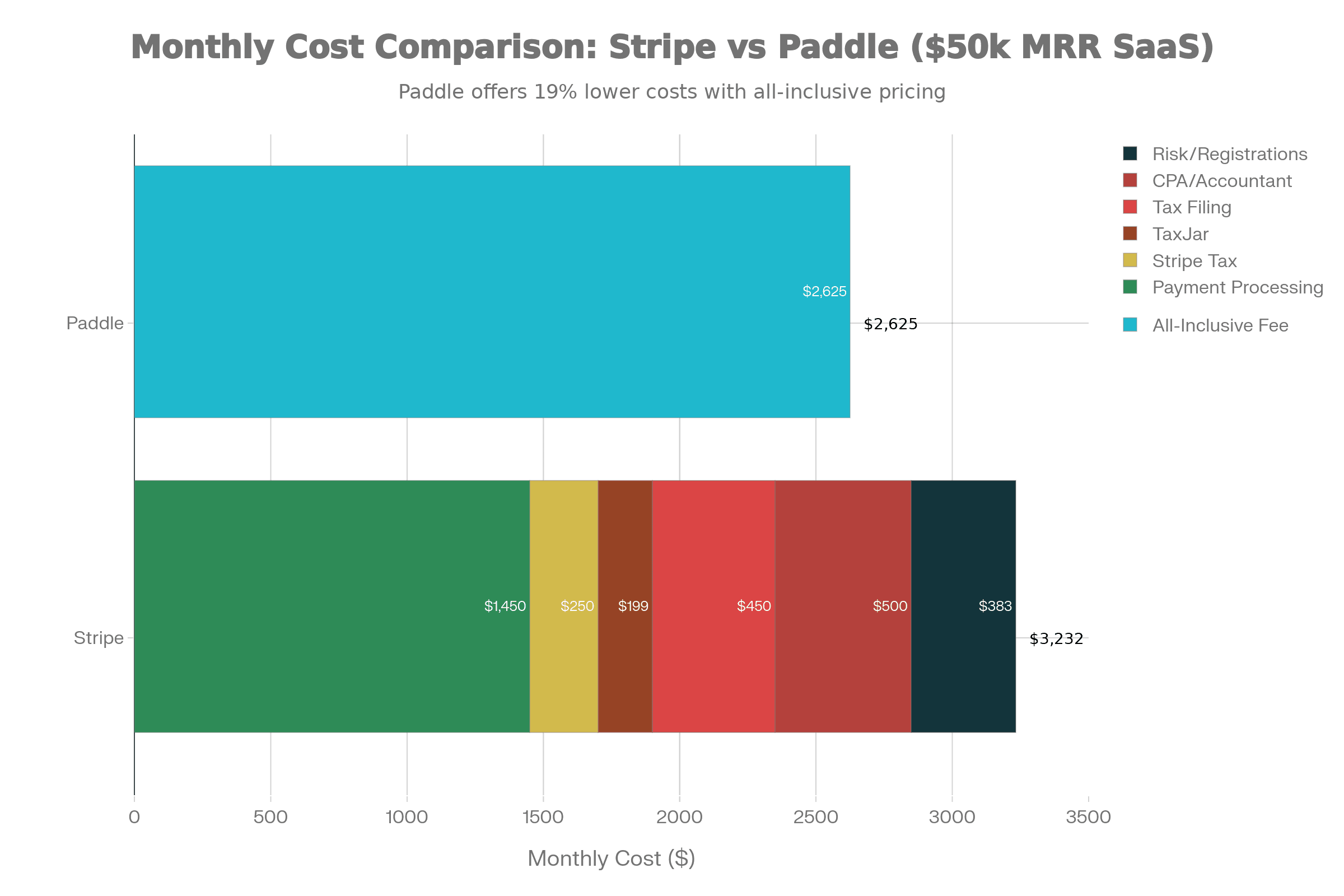
- Stripe Payment Processing: $1,450 (2.9% of $50k) [23]
- Stripe Tax (Calculation Only): $250 (0.5% of $50k) [25]
- TaxJar Professional: $199/month for automated sales tax calculations [29]
- Tax Filing Services: $450/month (10 jurisdictions at $45 per filing) [21]
- CPA Reconciliation: $500/month for quarterly compliance review and nexus monitoring
- Economic Nexus Tracking: $100/month (manual monitoring or Anrok add-on) [27]
- Annual Tax Registrations: $83/month amortized ($1,000/year for 10 jurisdictions) [21]
- Risk Buffer: $200/month (late filing penalties, audit prep)
Total Stripe Stack: $3,232/month ($38,549/year)
Compare this to Paddle’s all-inclusive $2,625/month ($31,500/year for 5% + $0.50 per transaction) [1]. The 5% fee includes payment processing, global tax registration in 100+ jurisdictions, monthly/quarterly filing, remittance to tax authorities, and legal liability for tax errors [4].
📝 How We Calculated These Numbers (Methodology)
To ensure this audit is fair and transparent, we modeled a specific mid-market SaaS scenario rather than using generic averages:
- Scenario: B2B SaaS company with $50k MRR and $200 Average Order Value (250 transactions/month).
- Geography Breakdown: 40% US (Nexus triggered in 5 states), 30% EU, 10% UK, 20% Rest of World (no tax).
- Stripe Stack Assumptions: Includes “TaxJar Professional” ($199/mo) required for automated reporting, plus a conservative CPA retainer ($500/mo) for quarterly nexus checks and filing oversight.
- Paddle Stack Assumptions: Standard pricing of 5% + $0.50 per transaction. No custom enterprise discounts applied.
The Merchant of Record Advantage: Who Goes to Tax Jail?
As a Merchant of Record, Paddle becomes the legal seller of your products [8]. This distinction fundamentally shifts tax compliance responsibility:
What Paddle Does (That Stripe Doesn’t)
| Tax Compliance Task | Paddle (MoR) | Stripe Tax |
|---|---|---|
| VAT/GST/Sales Tax Calculation | ✅ Included | ✅ Included (0.5% fee) [25] |
| Tax ID Registration (100+ jurisdictions) | ✅ Paddle registers | ❌ You register manually [21] |
| Monthly/Quarterly Tax Filing | ✅ Paddle files | ❌ You file via TaxJar/CPA [29] |
| Tax Remittance to Governments | ✅ Paddle pays | ❌ You pay manually |
| Economic Nexus Monitoring | ✅ Automatic tracking | ❌ Manual monitoring required [27] |
| Audit Liability | ✅ Paddle assumes legal risk | ❌ Your company audited |
| EU VAT MOSS Registration | ✅ Single registration for 27 countries | ❌ You register in each country |
Paddle handles tax registration, filing, and remittance in over 100 jurisdictions [4]. When tax authorities audit transactions, they audit Paddle’s books, not yours. One SaaS founder on Reddit summarized it: “Stripe Tax calculates VAT but doesn’t file it. I still need TaxJar ($199/mo) + an accountant ($500/mo). Paddle does all of this for the 5%.” [9]
The FTC Settlement: Legitimacy Concerns Addressed
In 2025, Paddle paid a $5 million FTC settlement for facilitating tech-support scam payments through its MoR infrastructure [web:2] [web:5]. Paddle disputes processing those specific transactions, stating the fine relates to third-party abuse of the platform. For legitimate SaaS businesses, Paddle’s MoR model remains operationally valid—they process over $4 billion annually [web:8]. However, this incident highlights the importance of vetting any Merchant of Record partner, as they legally represent your brand in customer transactions.
The Developer Reality Check: What Your Engineering Team Will Complain About
📢 Note to the Engineering Team:
Paddle’s API has constraints that will frustrate developers accustomed to Stripe’s flexibility:
- Rate Limits: 240 requests/minute maximum [2] [11]—compared to Stripe’s 6,000/minute. Exceeding this triggers 429 errors and temporary blocks [12] [13].
- Checkout Customization: You cannot fully customize checkout UI/CSS like Stripe [3] [web:3]. Paddle controls the branded checkout flow to maintain PCI compliance as the MoR.
- Discount Management: “Quite limited” according to December 2025 G2 reviews—no native bulk code generation [3].
- Integration Ecosystem: Fewer third-party connectors than Stripe, though Churnkey and Framer support exists [16].
🛡️ For the Founder: Does This Matter?
No. You trade 10% UI flexibility for 100% tax compliance automation. The 240/min rate limit handles up to 345,600 API calls daily—sufficient for SaaS businesses under $5M ARR. The checkout customization constraint is the price of having Paddle:
- Register for VAT MOSS across 27 EU countries [4]
- Monitor economic nexus thresholds in 50 U.S. states
- File 120+ tax returns annually on your behalf
This saves you 15-20 hours per month that your finance team would spend reconciling TaxJar → Stripe → QuickBooks → government portals. At a $50/hour valuation, that’s 240 hours annually worth $12,000—on top of the $7,049 cash savings.
What Verified Users Say (December 2025 G2 Reviews)
G2 reviews from December 2025 highlight consistent strengths [3]:
- “Support team is responsive and helpful”
- “Handles taxes, compliance, subscription management smoothly, so I can focus on developing products”
- “Reliable checkout system and international coverage help increase conversions”
The platform ships quarterly major updates [6]. November 2025 releases included a dashboard redesign and expansion to 60+ local payment methods (KakaoPay, NaverPay for Korean markets). Paddle Retain uses AI to predict churn risk based on payment failure patterns and automate dunning workflows [5], though this is a premium add-on beyond the base 5% fee.
The Break-Even Analysis: When Does Paddle Stop Making Sense?
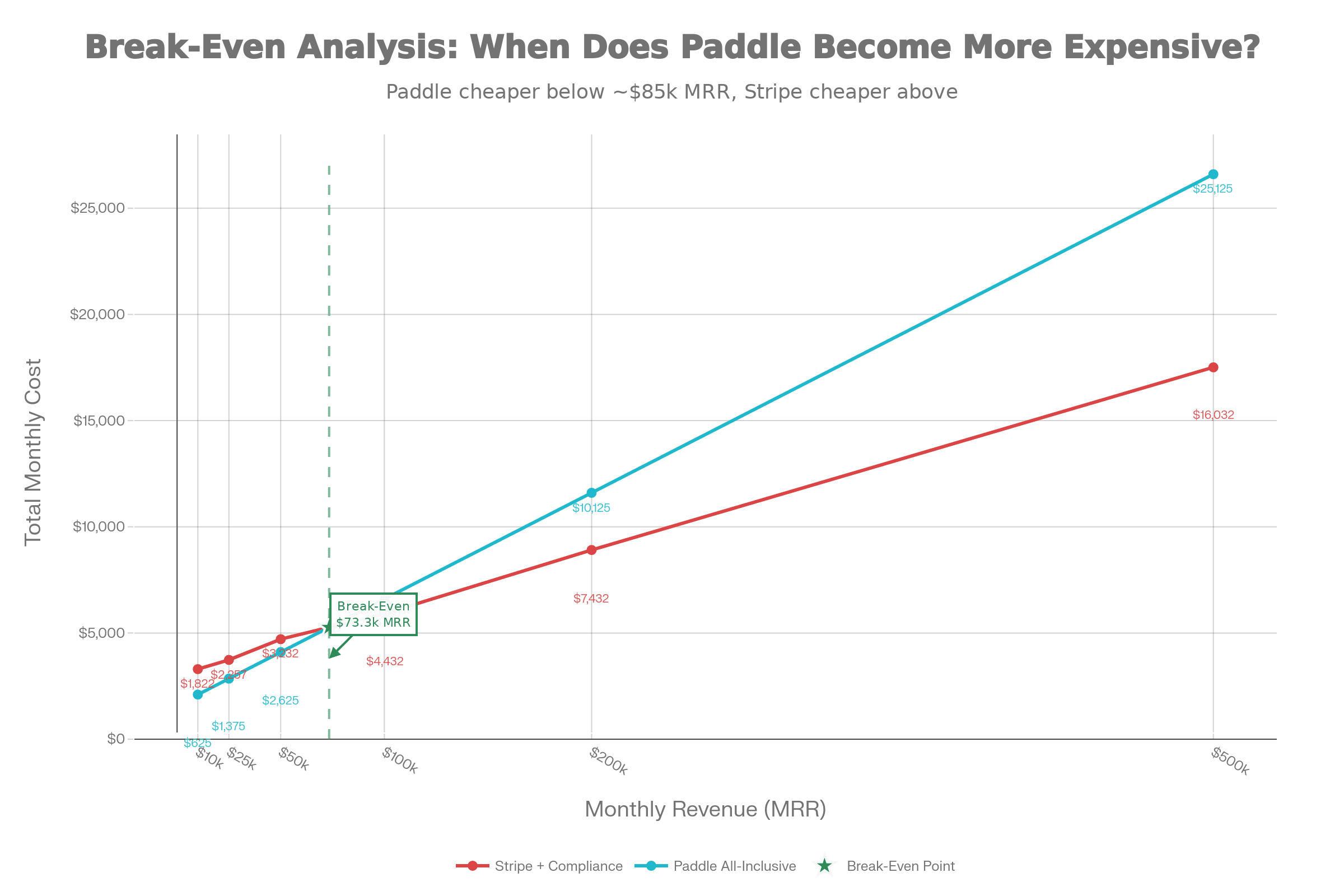
Paddle’s 5% fee becomes more expensive than Stripe’s unbundled stack at approximately $85,000 MRR—assuming you need multi-jurisdiction tax compliance. Below that threshold, the fixed costs of TaxJar ($199), filing services ($450), and CPA reconciliation ($500) make Stripe’s total cost higher despite the lower percentage fee.
Choose Paddle If You Check 3+ of These:
- ✅ You sell to customers in 5+ countries (EU VAT, UK, Australia, Canada, multi-state U.S.)
- ✅ Your MRR is between $20k-$500k (the cost-efficiency sweet spot)
- ✅ You don’t employ a dedicated tax compliance manager
- ✅ You value liability protection over API flexibility
- ✅ Your finance team’s time is better spent on forecasting than TaxJar reconciliation
- ✅ You’ve triggered economic nexus in multiple U.S. states but haven’t registered yet
Choose Stripe If You Check 3+ of These:
- ✅ You operate in 1-2 U.S. states only (minimal tax complexity) [21]
- ✅ Your MRR is under $15k (5% fee too expensive) or over $1M (negotiate custom Stripe rates) [23]
- ✅ You need extreme checkout customization or white-label payment flows
- ✅ You already employ a full-time tax accountant ($75k/year salary) [27]
- ✅ Your product requires 6,000+ API calls/minute [11]
- ✅ You prefer unbundled services where you control each component
⚖️ A Counter-Perspective: Why a CPA Might Prefer Stripe
“If a company plans to go public (IPO), we often prefer Stripe. It keeps the financial data ‘raw’ and in-house, giving us granular control over revenue recognition policies (ASC 606). Paddle’s MoR model simplifies things by ‘black-boxing’ the revenue, which can be annoying for enterprise-grade audits later on.”
LumScope’s Take: Valid point. If you are prepping for an IPO, use Stripe. If you are trying to survive to $1M ARR, use Paddle.
The Verdict: Is 5% Still Worth It in December 2025?
Buy Paddle if: You’re a founder who values sleep-at-night compliance over developer flexibility, operates in multiple tax jurisdictions, and would rather invest 240 hours annually into product development than tax reconciliation. The $7,049 cash savings plus eliminated audit risk justifies the 2.1% premium over Stripe’s base rate [1] [23].
Avoid Paddle if: You operate in a single low-complexity market, your engineering team requires deep payment flow customization, or you’ve already built tax infrastructure with in-house expertise. The 5% fee becomes pure overhead once you surpass $85k MRR without international expansion.
The question isn’t whether 5% is expensive. It’s whether $7,049 annually + 240 hours of reclaimed time + zero tax audit liability is worth 2.1% more in fees. For SaaS founders expanding globally between $20k-$500k MRR, the math favors Paddle—even if your CTO disagrees.
Sources & References
Primary Documentation
- Paddle Pricing: paddle.com/pricing
- Paddle Developer Documentation
- G2 Verified Reviews (Dec 2025)
- How Paddle Handles VAT (Official Guide)
- Paddle Retain (AI Churn Prevention)
- Product Updates Nov 2025
Third-Party Analysis
- Flowjam: Paddle vs Stripe Comparison
- Reddit SaaS Discussion: VAT Taxes
- FTC Settlement Analysis (JD Supra)
- Reddit: MoR Limitations
- LinkedIn: FTC Settlement Discussion
- What is a Merchant of Record?